


Views: 0 Author: Site Editor Publish Time: 2026-10-20 Origin: Site


Picture a massive industrial plant. Thousands of identical wires weave through overhead trays and snake behind heavy machinery. In this high-stakes environment, unlabeled lines create dangerous operational chaos. When a critical system fails, troubleshooting takes hours instead of minutes. This delay risks severe downtime and massive financial losses.
Implementing a rigorous Cable Identification protocol systematically solves this problem. It transforms a tangled web of confusion into a highly organized infrastructure. In this guide, we explore exactly where and how to use these vital tools. We will compare modern materials, review specific product capabilities, and provide actionable installation strategies for your next heavy-duty project.
Operational Efficiency: Standardized labeling measurably reduces troubleshooting time and accelerates maintenance workflows across complex infrastructures.
Application-Specific Tooling: Marker tags handle individual wires and localized bundles. Industrial plates deliver high-visibility data for macro-level components like control panels.
Material Durability: Environmental variables dictate material choice. Ultraviolet exposure, chemical presence, and extreme temperatures demand robust solutions like marine-grade stainless steel.
Regulatory Compliance: Strict adherence to established industry protocols is mandatory for passing safety audits and maintaining operational legality.
Before diving into the hardware, we must acknowledge a major shift in industrial infrastructure management. Modern facilities are rapidly adopting digital twin technologies and predictive maintenance models. Physical infrastructure is no longer isolated. It is meticulously mapped into complex digital ecosystems.
Consequently, physical labeling must bridge the gap between the tangible wire and the digital database. The industry trend heavily favors permanent, highly durable identification methods over temporary adhesive labels. This approach ensures that field technicians can instantly sync physical assets with centralized management software, guaranteeing that maintenance logs remain perfectly accurate over the facility's lifespan.
In demanding environments like hyperscale data centers or offshore drilling rigs, wire management extends beyond physical routing. Accurate and durable identification forms the baseline of any secure infrastructure. Without a standardized methodology, technicians rely on manual tracing. This practice introduces significant risk and profound inefficiency.
A cable marker is a specialized tool attached directly to individual lines or localized bundles. These identifiers come in various forms, including rigid metal tags secured by stainless steel ties. Their primary function is to provide immediate data about a specific connection.
A standard tag displays alphanumeric codes indicating the source, destination, and specific function. In harsh settings, engineers specify components manufactured from 304 or 316-grade stainless steel. Utilizing laser engraving ensures the text remains perfectly legible despite mechanical abrasion or caustic chemical exposure.
While individual tags handle micro-details, an industrial Name Plate serves a macro-level purpose. These are larger, rigid identifiers mounted directly onto structural components. Common installation sites include main control panels, high-voltage junction boxes, and primary routing trays.
They broadcast broad system information such as panel designations and circuit capacities. Working in tandem with granular markers, they establish a hierarchical system. This logical structure allows engineers to navigate seamlessly from the macro structure down to the micro details.
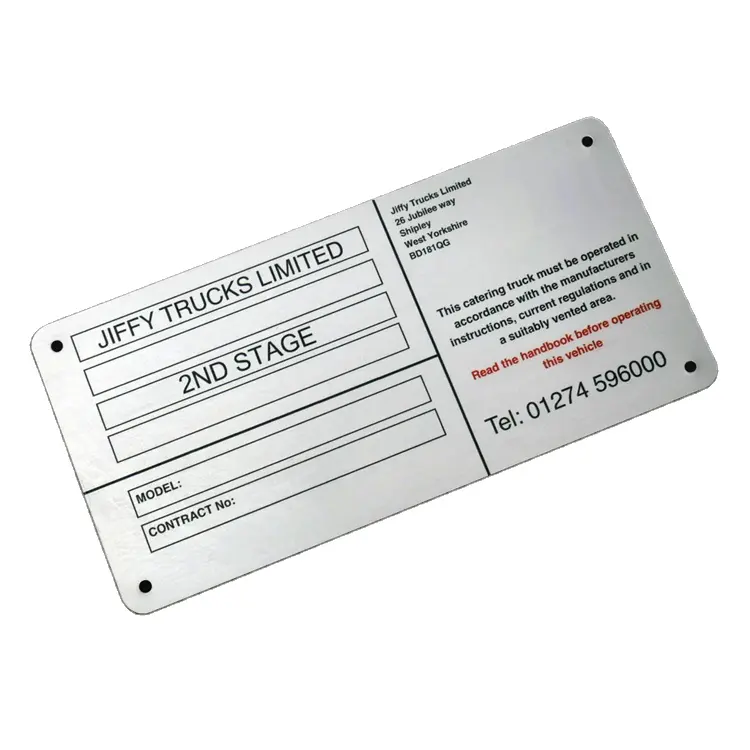
The strategic deployment of physical identification hardware directly impacts a facility's operational uptime. Industrial plants simply cannot afford to treat labeling as an afterthought. It represents a fundamental pillar of risk management.
Network performance relies on the speed of resolving physical layer issues. Imagine a scenario where a 480V power relay faults. Technicians must isolate the problematic line immediately. In an undocumented system, this requires sequential testing through miles of conduit.
A comprehensive labeling strategy eliminates this diagnostic delay. When every line is clearly marked at its source and destination, technicians can instantly cross-reference tags with digital schematics. This direct correlation minimizes mean time to repair and preserves critical uptime.
Beyond pure efficiency, clear identification is a non-negotiable safety requirement. Industrial environments inherently involve high-voltage power feeds and volatile control circuits. If a worker cannot definitively identify a specific feed, the risk of accidental severance increases exponentially.
Cutting an unidentified live power line can result in devastating arc flashes and severe personnel injury. Markers act as a vital front-line defense. They are integral to strict Lockout Tagout procedures, ensuring maintenance personnel verify exactly which circuits are safely de-energized.
Selecting the correct identification hardware requires understanding the specific application and spatial constraints. Differentiating between these tools ensures a logically organized facility.
Tool Type | Primary Application | Ideal Location | Recommended Material |
|---|---|---|---|
Cable Marker Tag | Micro-level wire isolation and data mapping | Individual wires, fiber strands, small bundles | 316 Stainless Steel, Laser Engraved |
Industrial Name Plate | Macro-level system warnings and navigation | Control panels, junction boxes, cable trays | Anodized Aluminum or Heavy-Duty Steel |
Pipe Marker | Fluid and gas hazard identification | Steam lines, chemical pipes, cooling systems | Industrial Vinyl with Protective Overlaminate |
These tags are optimal for high-density wiring environments. In confined locations like server racks or complex machinery harnesses, hundreds of identical lines run parallel. Technicians frequently utilize stainless steel marker ties featuring a built-in flat surface. This dual-purpose design allows for precision organizing while providing a highly visible platform for identification.
Conversely, broad plates are deployed when information must be visible from a distance. They provide essential macro-level navigation. For example, a technician affixes one to the exterior of a distribution panel. This boldly displays the panel ID and voltage rating. They provide the navigational context that guides personnel to the correct general area.
Electrical infrastructure relies on tags and plates, but fluid containment systems require a different approach. A standardized Pipe Marker wraps around piping systems to identify hazardous contents like high-pressure steam or caustic chemicals. While these labels identify fluid mechanics, wire markers identify electrical flow. Utilizing both systems ensures universal plant safety.
The physical reality of an industrial plant dictates the required manufacturing technology. Selecting inadequate materials leads to premature degradation and costly replacements.
Legacy solutions typically involve polymer-based wraps or adhesive stickers. These options are highly cost-effective and easy to print on-site. Consequently, they suit indoor, climate-controlled environments perfectly.
However, polymer labels are highly vulnerable to environmental degradation. Under brutal industrial conditions, they fade from ultraviolet exposure, melt under high ambient temperatures, and dissolve when exposed to machine lubricants.
For harsh environments, laser-marked metals represent the empirical standard. Drawing from real-world product specifications, premium stainless steel cable markers are manufactured from 304 or 316-grade alloys. These materials feature exceptional tensile strength and extreme temperature resistance.
Manufacturers use high-powered lasers to anneal the surface, creating permanent text. This ensures the identification survives saltwater corrosion, extreme weather, and physical abrasion. For instance, marine-grade 316 stainless steel tags are virtually impervious to industrial solvents, making them mandatory for petrochemical processing plants and offshore rigs.
Objective adherence to industry standards is a strict legal mandate. Facilities failing to comply face failed inspections and massively increased liability.
The National Electrical Code dictates baseline safety requirements for electrical installations. The code explicitly requires clear, durable identification for specific circuits, particularly grounded conductors and high-voltage feeds. It mandates that labels must withstand their specific installation environment.
For telecommunications, the Telecommunications Industry Association provides rigorous standards. This framework outlines a comprehensive administration system. It defines exactly how identifiers should be formatted, specifying that labels must logically indicate the exact floor, telecom room, patch panel, and port.
To maintain a perpetually audit-ready facility, plant managers should implement a standardized protocol. Consider the following structural checklist:
Material Compliance: Verify that exposed hardware utilizes corrosion-proof materials like marine-grade 316 stainless steel.
Standardized Nomenclature: Ensure all alphanumeric codes strictly follow facility-wide formatting rules. Avoid handwritten conventions entirely.
Color-Coding Integration: Utilize standardized color codes to visually differentiate between critical systems.
Legibility and Sizing: Confirm that text size is appropriate for the intended viewing distance.
Procuring the correct hardware is only the first step. Long-term success relies heavily on precise installation. Inconsistent application renders the entire system ineffective.
The fundamental rule of physical identification is dual-end labeling. A technician should never guess a line's origin. A marker must always be placed at the source and the destination. Both ends must feature identical data.
Furthermore, dual-end labeling alone is insufficient for extended runs traversing multiple rooms. Imagine a technician tracing a fault along a massive overhead tray. They need periodic verification. Installers must place additional identifiers at regular intervals—typically every 3 to 5 meters—and at every critical transition point.
Even with premium materials, installation errors compromise network integrity. A frequent mistake involves applying indoor-rated materials in harsh settings. Utilizing standard adhesive wraps in high humidity results in rapid degradation.
Another critical error occurs during physical attachment. Zip ties must be applied with carefully calibrated tension. Over-tightening a tie around copper data lines crushes the internal geometry, causing signal crosstalk. In fiber optic applications, excessive compressive force causes micro-bending, which severely degrades network throughput. Installers must use calibrated tensioning tools to secure ties firmly without compressing the delicate outer jacket.
Proper industrial cable management demands strategic planning and uncompromising execution. Placing tags correctly at regular intervals actively prevents costly maintenance errors and slashes troubleshooting times. By integrating heavy-duty plates and fluid markers, facility managers ensure comprehensive navigational clarity.
Investing in permanent, laser-engraved identification upfront saves significant operational funds over the lifespan of a facility. High-quality hardware prevents catastrophic system downtime and protects personnel from severe electrical hazards. Evaluate your current infrastructure today. Discard failing legacy labels and upgrade to industrial-grade identification solutions. For premium 304 and 316 stainless steel identification tools engineered for extreme environments, explore the robust product lineup at Supercleat to guarantee superior network reliability and total regulatory compliance.
Stainless steel, specifically the 316 marine-grade alloy, stands as the most durable material available. When combined with deep laser-engraved text, a stainless steel tag offers unparalleled resistance to harsh environmental factors. It is highly impervious to oxidation, saltwater corrosion, extreme temperature fluctuations, and prolonged ultraviolet exposure. Unlike plastics that become brittle, laser-marked stainless steel remains structurally intact for the machinery's entire operational lifespan.
While standard nylon ties are highly effective for physically bundling wires, they do not provide a dedicated surface for identification. Marker ties are specifically manufactured with a built-in flat flag designed to hold text or custom engravings. By utilizing them, technicians accomplish mechanical organization and precise identification in a single step. Attempting to attach separate labels to standard curved zip ties often results in poor adhesion and eventual label failure.
No, they are governed by distinct regulatory frameworks, although both are critical for facility safety. Fluid and gas identification generally follows specific mechanical engineering standards determining color codes and placement rules for hazardous contents. Conversely, electrical labels are primarily guided by the National Electrical Code and telecommunications standards. However, the Occupational Safety and Health Administration mandates the proper use of both systems to guarantee a hazard-free working environment.
The replacement frequency is entirely dependent on the initial material selection and the operating environment. If a facility invests in high-quality laser-marked stainless steel tags, these items are generally considered permanent. They are designed to outlast the infrastructure itself and rarely require replacement unless the system is decommissioned. In contrast, legacy labeling solutions utilizing plastics or adhesives are highly susceptible to environmental degradation, often necessitating replacements every two to five years.
Color coding depends heavily on the specific industry and the type of system being identified. In electrical systems, red typically denotes fire alarm or emergency circuits, orange indicates high-voltage lines, and blue is reserved for data communications. Adhering to these visual standards allows field engineers to instantly recognize the risk level and function of a conduit before reading the detailed alphanumeric text.
In settings like heavy manufacturing plants or generator rooms, constant vibration can cause standard plastic zip ties to snap due to fatigue. For these applications, engineers must use stainless steel cable ties featuring a self-locking ball bearing mechanism. This ensures the tag remains securely fastened to the wire bundle without loosening over time. Additionally, applying a specialized cushioning sleeve under the metal tie prevents abrasion against the wire jacket during continuous vibration.


