


Views: 0 Author: Site Editor Publish Time: 2026-09-09 Origin: Site


A short circuit doesn't just trip a breaker. It generates explosive electromechanical forces that can cause heavy industrial cables to whip violently across a room. This dangerous event risks severe equipment damage, costly operational downtime, and catastrophic safety hazards for on-site personnel.
With a flooded market of restraint materials, project managers and electrical engineers often struggle to navigate the complex balance between safety, longevity, and budget. On the job site, specifying the wrong material isn't just an administrative error—it is a critical safety failure waiting to happen.
In this comprehensive guide, we will break down the distinct advantages, potential drawbacks, and ideal field applications for the three primary material options: stainless steel, aluminum, and advanced plastics. By understanding exactly how each material behaves under massive electromechanical stress, you can make a highly informed purchasing decision tailored to your specific infrastructure needs.
Stainless Steel delivers the highest tensile strength and extreme corrosion resistance. It is the ultimate choice for harsh, offshore, or heavy industrial environments where structural failure is simply not an option.
Aluminum provides a highly practical balance of mechanical strength and lightweight handling. It is naturally non-magnetic, making it ideal for indoor industrial applications where magnetic eddy currents around single-core cables are a primary thermal concern.
Plastic (Polymer/Nylon) is highly cost-effective, flexible, and inherently non-conductive. It is perfectly suited for lower voltage, commercial, and less demanding environmental conditions where extreme physical fault forces are mathematically unlikely.
Choosing the correct material depends entirely on your project’s calculated peak short-circuit fault level, direct environmental exposure, and overall capital budget.
Recent market data and global engineering publications highlight a fascinating shift in how we specify materials. With the massive expansion of renewable energy grids (solar and wind) and hyper-scale data centers, there is an increasing reliance on lightweight, non-magnetic materials. Aluminum and advanced polymers are dominating these sectors because they prevent eddy currents and speed up manual installation.
Conversely, traditional sectors such as marine, offshore oil, and heavy manufacturing continue to drive unyielding demand for high-grade steel alloys. The consensus among senior electrical engineers is clear: no single material dominates every sector. Selection is now highly contextual, driven strictly by calculated fault data rather than generic preferences.
To make a precise material selection, you must first understand the fundamental mechanics at play. In electrical engineering, a cleat is a critical safety device. Its primary job is to anchor cables in place and absorb the immense forces generated during a sudden short-circuit event.
Imagine a high-voltage fault in a bustling substation. The current spikes dramatically in milliseconds. This creates intense magnetic fields that push adjacent cables apart with explosive force. Without proper restraint, these cables will break free, destroying containment trays and tearing through surrounding infrastructure.
Consequently, the structural integrity of the restraint system is paramount. A safety device is only as reliable as the raw material it is forged from. If you specify an inadequate material, the installation can degrade prematurely from ultraviolet (UV) exposure, corrode from airborne pollutants, or completely shatter during a high-fault surge.
From a risk mitigation perspective, specifying the correct power cable fixing solution prevents costly downtime. Aligning your material choice with rigorous international safety standards—most notably IEC 61914—guarantees a compliant, future-proof installation.
When engineering projects demand uncompromising safety margins, 316L stainless steel is universally recognized as the gold standard. The strategic addition of molybdenum in the 316L alloy provides exceptional resistance to pitting and crevice corrosion. This ensures long-term stability in the most aggressive industrial zones.
Specifically, when dealing with Trefoil formations, a stainless steel cable cleat is often tested to withstand peak short-circuit currents exceeding 130kA. It is built for worst-case scenarios.
Unmatched Tensile Strength: Stainless steel yields the highest mechanical retention among all restraint materials. It is engineered to contain the extreme forces associated with massive short-circuit fault levels.
Superior Corrosion Resistance: The 316L grade is specifically formulated to withstand rust, oxidation, and degradation from harsh chemicals, saltwater spray, and airborne industrial pollutants.
Fire and Thermal Endurance: Metal maintains its structural integrity at exceptionally high temperatures. In the event of a facility fire, these restraints will not melt or contribute to the fuel load.
While performance is stellar, the raw material and intensive manufacturing processes make stainless steel more expensive. Furthermore, the high density of the metal makes the components heavier. This slightly increases transportation costs and can slow down manual installation on-site.
Due to its rugged nature, stainless steel represents the ultimate investment for severe environments. Picture a salt-sprayed offshore oil rig, a damp underground mining operation, or a highly corrosive chemical processing plant. These are the precise arenas where 316L steel proves its worth day after day.
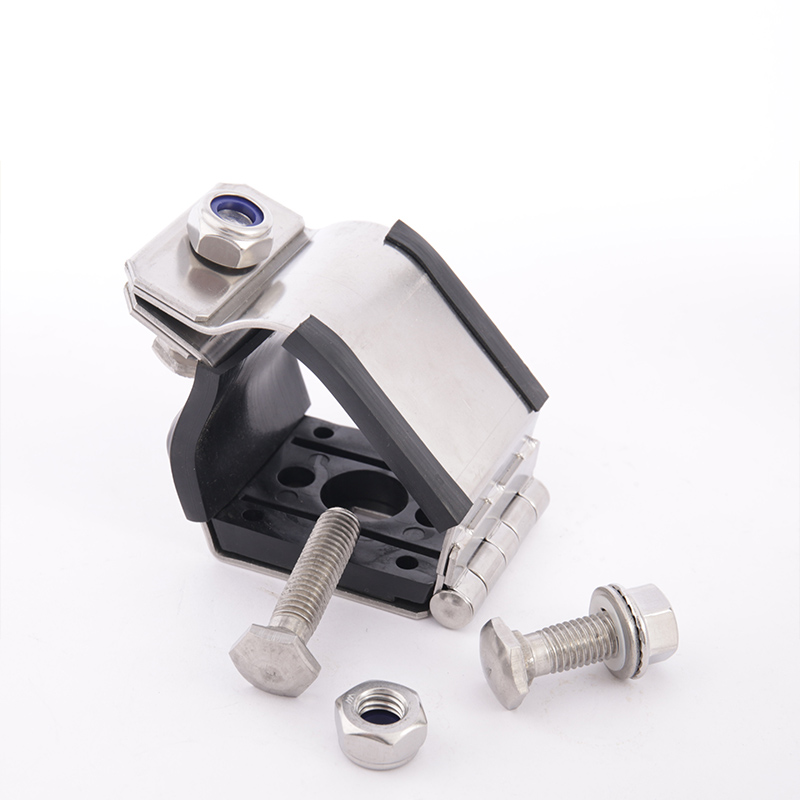
For many large-scale applications, heavy-duty steel may be over-engineered and cost-prohibitive. Aluminum enters the equation here as the perfect middle-ground material. It delivers impressive mechanical strength without the cumbersome weight of steel.
Non-Magnetic Properties: This is arguably aluminum's most vital characteristic. When routing single-core AC lines, magnetic materials induce eddy currents, leading to localized heating that melts cable sheathing. Aluminum is completely non-magnetic, eliminating this thermal hazard.
High Strength-to-Weight Ratio: Offering substantial short-circuit containment while remaining exceptionally light, aluminum components are much easier for technicians to handle.
Cost-Effective Durability: Bridging the gap between polymer and steel, an aluminum cable cleat offers high-tier mechanical protection at a far more accessible price point.
As engineers, we must be wary of galvanic corrosion. Aluminum is susceptible to rapid degradation if placed in direct contact with dissimilar metals (like galvanized steel trays) in the presence of moisture. If you are mounting raw aluminum outdoors, galvanic corrosion will eat it alive. Always specify epoxy-coated versions for these transitions.
Aluminum is the smartest specification for controlled, dry environments. They are predominantly utilized in indoor substations, dry manufacturing plants, sprawling data centers, and renewable energy facilities where high structural strength and non-magnetic properties are non-negotiable.
Modern engineering plastics have evolved far beyond basic organizational zip-ties. Today’s polymer restraints are typically manufactured from advanced composites such as glass-filled nylon, Low Smoke and Fume (LSF), or Low Smoke Zero Halogen (LSOH) materials. These rigorous advancements have transformed plastic into a legitimately tested safety component.
Highly Budget-Friendly: As the most economical material available, plastic dramatically reduces both material procurement and shipping costs. Its feather-light profile allows for rapid deployment across massive commercial sites.
Naturally Corrosion-Resistant: Polymers are inherently immune to rust and galvanic corrosion. In addition, their non-conductive nature adds an extra layer of electrical insulation safety.
Gentle on Cable Sheathing: The slightly softer, forgiving nature of a plastic cable cleat significantly minimizes the risk of physical abrasion to the outer cable jacket during installation or minor thermal expansion.
Despite their evolution, engineered plastics cannot match the sheer tensile strength of metal alloys. They are strictly not recommended for networks with extreme high-fault short-circuit risks. Moreover, standard untreated plastics can become brittle and shatter if exposed to intense, prolonged ultraviolet (UV) light or freezing outdoor temperatures.
Plastic fits perfectly into budget-conscious commercial projects requiring standard support. They shine in light industrial builds, indoor telecommunications routing, and lower-voltage installations where the mathematical risk of massive electromechanical force is minimal.
To streamline your decision-making process on the job site, we have compiled a quick visual reference comparing the three primary materials across critical performance metrics.
Performance Metric | Stainless Steel (316L) | Aluminum (Bare/Coated) | Plastic (Polymers) |
|---|---|---|---|
Strength & Short-Circuit Resistance | Winner: Unmatched containment for extreme fault levels (100kA+). | Runner-up: Excellent strength for medium-to-high faults. | Adequate: Suitable for low-to-medium fault applications. |
Corrosion Resistance | Winner: Superior resistance to chemicals and saltwater. | Conditional: Requires dry environments or epoxy coatings. | Runner-up: Naturally rust-proof, but vulnerable to UV if untreated. |
Magnetic Properties | Weakly Magnetic / Magnetic. | Winner: 100% non-magnetic, prevents eddy currents. | Winner: 100% non-magnetic and non-conductive. |
Budget & Installation Speed | High Cost: Slower installation due to heavy weight. | Medium Cost: Faster installation due to lighter weight. | Winner: Lowest cost and fastest installation speed. |
Selecting the right material is a precise science. It requires a systematic evaluation of your unique project parameters. Stop guessing and deeply assess the following factors before finalizing a purchase order.
The ambient conditions of your site will often eliminate certain materials immediately. Ask yourself: Will the installation face corrosive chemical washdowns, saltwater spray, or wild temperature fluctuations? If yes, 316L Stainless Steel is mandatory. If the setup is outdoors beneath beating sunlight, you must specify metal or a heavily UV-stabilized Plastic. For clean, climate-controlled indoor spaces, Aluminum or standard LSOH Plastic will perform flawlessly.
The peak short-circuit fault current (denoted as $I_p$) dictates the required mechanical strength of the restraint. Because electromechanical force is directly proportional to the square of the peak current, even a marginal increase in fault current results in an exponential physical load. If your calculated peak fault is above 100kA, you are firmly in stainless steel territory.
The physical arrangement of the cables heavily influences material choice. When routing single-core AC cables individually, the alternating electromagnetic field induces eddy currents in surrounding magnetic materials. Utilizing standard magnetic steel here will cause the restraint to heat up rapidly. This excessive heat melts the cable insulation and can spark a fire. In these single-core scenarios, non-magnetic Aluminum or Plastic are strict engineering requirements.
Understanding technical specifications is only the first phase of procurement. The subsequent, and arguably more critical phase, involves sourcing these components from manufacturers that adhere to verifiable testing protocols.
When evaluating vendors for your industrial cable support infrastructure, objective certification must be your primary filter. Look for manufacturers that subject their products to strict third-party testing according to IEC 61914 standards. This certification provides empirical proof—not just marketing claims—that the product will perform exactly as expected during a volatile short-circuit event.
For procurement managers seeking uncompromised quality, partnering with a specialized manufacturer ensures your installation remains safe and operational for decades. Your electrical infrastructure represents a massive investment that demands guaranteed longevity. Always evaluate your specific environmental hazards and calculate exact fault conditions before making a decision.
If you are ready to match your calculated fault levels and environmental needs with certified, field-tested products, explore the full technical catalog at supercleat.com to secure the exact restraint materials your project demands.
Yes, provided the specific polymer formulation (such as engineered glass-filled nylon) is explicitly UV-stabilized by the manufacturer. Standard, untreated plastics will undergo severe photo-oxidation under prolonged sunlight, causing the material to become brittle and drastically reducing its mechanical strength during a short-circuit event.
Magnetic materials interact aggressively with the alternating electromagnetic fields generated by single-core AC cables. This interaction induces eddy currents within the metal, leading to severe localized heating. This excessive heat can quickly melt the cable's outer sheathing and compromise the core insulation. Non-magnetic materials like aluminum or polymer are strictly required for these specific formations.
Aluminum does not rust in the traditional sense, as it contains no iron. However, it is highly susceptible to galvanic corrosion if it comes into direct contact with dissimilar metals (like zinc-galvanized steel trays) in the presence of an electrolyte like moisture. This chemical reaction can be effectively mitigated by using isolation spacers or specifying epoxy-coated aluminum components.
Stainless steel becomes mandatory if your project parameters involve extreme environmental hazards or exceptionally high fault currents. Installations located in marine environments, offshore oil platforms, chemical processing plants, or heavy underground mining operations require the superior tensile strength and chemical resistance that only 316L stainless steel can provide.
Proper spacing depends entirely on the outer diameter of your cables and the calculated peak short-circuit fault current ($I_p$) of your system. Manufacturers provide spacing charts based on their IEC 61914 short-circuit testing results. As a rule of thumb, higher fault currents require closer spacing to adequately distribute the explosive electromechanical forces.
IEC 61914 is the globally recognized international standard for cable cleats used in electrical installations. It defines the rigorous testing protocols required to prove a product's resistance to electromechanical forces, temperature ratings, UV resistance, and corrosion limits. Specifying an IEC 61914 certified product ensures you are installing a verified safety device rather than a generic clamp.


